Nine hours. That’s what the Garmin said when I stopped it outside St Gilberts School in June last year, 161 kilometres and 1,290 metres of climbing later, having set off at 6am in the morning.
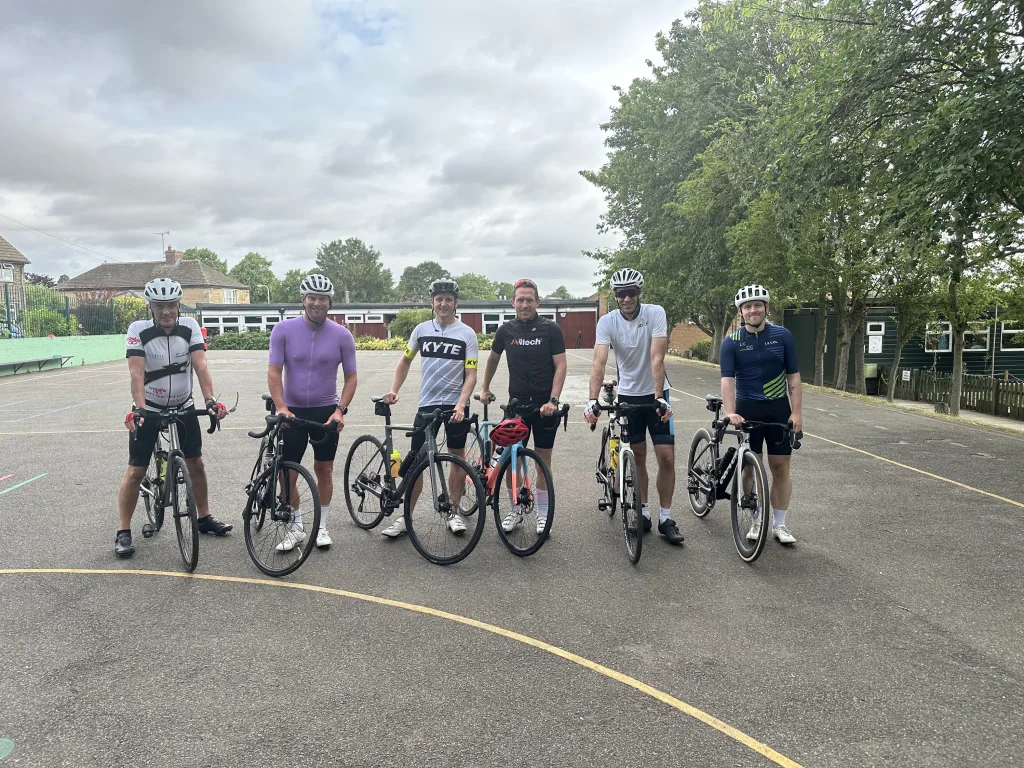
Here’s the bit nobody tells you though. Of those nine hours, I was only actually pedalling for six hours and fifty minutes. The other two hours and ten minutes I spent standing next to my bike – eating, refilling bottles and at one point having a genuinely extended conversation about nothing in particular while my legs quietly decided whether they fancied the rest of it.
That gap between nine hours of ride and seven hours of riding is the single most useful thing I learned, and it’s the thing that reframed the whole challenge for me. A hundred miles isn’t a fitness test. It’s a logistics exercise with a fitness component added on top.
This is the guide I wish I’d had eighteen months ago, when my longest ever ride was 50km and I’d just publicly committed to tripling it. We’re doing it again this year — Sunday 27th September 2026, as a group this time, raising money for St Gilbert’s PTA – and everything below is what I’d tell anyone thinking of joining us, or taking on their own first century.
What a century ride actually asks of you
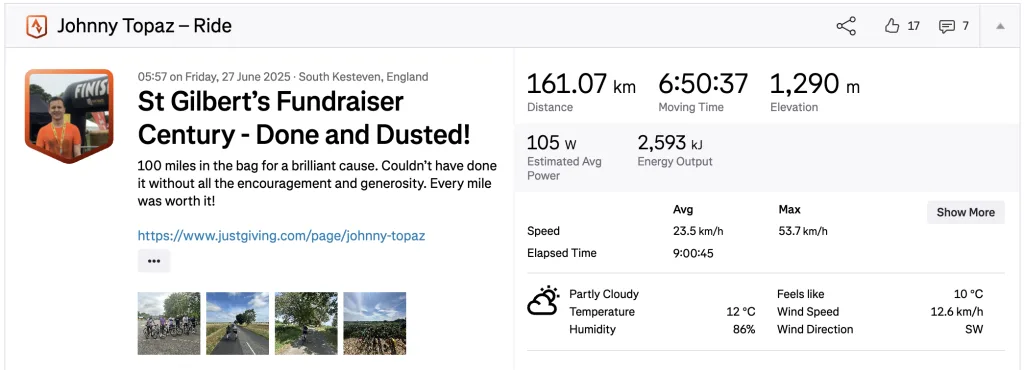
Let’s start with honest numbers, because vague encouragement doesn’t help anyone plan. Here’s what my first 100 miles genuinely looked like, straight off Strava:
| Stats | Distance and Time |
|---|---|
| Distance | 161.1km (100.1 miles) |
| Elevation gain | 1,290m (4,232ft) |
| Moving time | 6h 50m |
| Total elapsed time | 9h 01m |
| Time stopped | 2h 10m |
| Average moving speed | 23.5km/h (14.6mph) |
| Estimated calories burned | 5,532 |
| Heart rate data | None. I wasn’t even wearing a strap. |
The speed is slower than you’d guess. 23.5km/h average is well below the pace of our Sunday Social — on a still morning in August our regular club ride was averaging nearly 30km/h. Six kilometres an hour slower, all day. That was intentional to avoid running out of energy.
The climbing is real but it’s not mountains. 1,290m over 100 miles is what Lincolnshire and Rutland give you: no single climb that breaks you, just a relentless steady drip of 20 to 50 metre lumps. My biggest single climb that day was 53 metres. Fifty-three! And yet the cumulative effect by hour seven is very much a thing.
Nobody has a power meter and that’s fine. Those watt figures Strava gives me are estimates, not measurements. You do not need a power meter to ride a century. You need a bit of patience and a working sense of “this feels sustainable.”
Can you actually do it? An honest take
The question I get asked most is some version of “am I fit enough yet?”
Here’s my answer, and it’s based on being the least likely century rider in the club eighteen months ago. Before last summer, I had never ridden further than 50km in one go. Not once. I was a guy who ran a social cycling club and did 40km to 50km on Sunday mornings.
If you can currently ride 50 to 60km without it ruining your week, you can get to 100 miles with a sensible twelve-week build. That’s the baseline. Not a speed, not a wattage, not a weight – just the ability to do three-ish hours on a bike and still function afterwards.
If you’re below that, you’re not out of the running, you just need longer. Give yourself sixteen to twenty weeks and build a solid base fitness first.
And if you’re nowhere near that yet? Come and ride with us on a Sunday. That’s literally how most of our riders got started and nobody gets dropped.
The twelve-week plan
The principle is actually quite simple and almost everyone gets it wrong in the same direction: you build the long ride, and you leave everything else roughly alone.
Most first-timers try to get faster and longer at the same time, get tired, get ill and lose three weeks. Don’t do that. Your only real job is to teach your body — and your backside and your hands, and your stomach — to tolerate more hours.
| Week | Long ride | Rest of the week | What you’re actually training |
|---|---|---|---|
| 1 | 50km | 2 short rides (45–60 min) | Establishing the rhythm |
| 2 | 60km | 2 short rides | Getting used to a longer Sunday |
| 3 | 70km | 2 short rides, one with a few efforts | First taste of “that was long” |
| 4 | 45km (easy) | 1 short ride | Recovery week — non-negotiable |
| 5 | 80km | 2 short rides | Nutrition practice starts here |
| 6 | 90km | 2 short rides | Contact points start complaining |
| 7 | 100km | 2 short rides | Big psychological milestone |
| 8 | 60km (easy) | 1 short ride | Recovery week |
| 9 | 115km | 2 short rides | Fuelling plan gets tested properly |
| 10 | 130km | 1 short ride | Your longest ride. Full dress rehearsal. |
| 11 | 90km | 2 short, easy | Beginning of the taper |
| 12 | 50km early in week | Nothing after Wednesday | Taper. Resist the urge. |
You never need to ride 100 miles in training. 130km is about 80 miles and it’s plenty. Event-day adrenaline, company, and a properly planned route will carry you the last 30km. Riding the full distance in training just buys you fatigue you have to recover from.
Long rides go up by roughly 10 to 15% at a time. Jumping from 70km to 110km because you felt great is how people end up injured or hollowed out in week seven.
The recovery weeks are the training. You don’t get fitter on the ride, you get fitter recovering from it. Skipping week four because you feel good is the single most common way to arrive at week ten already cooked.
Two short midweek rides beat one long one. Even 45 minutes twice a week keeps the legs turning over. Commutes count. Turbo sessions count.
If you’ve only got a few weeks
Let’s be realistic about the calendar: if you’re reading this in the run-up to the 27th, twelve weeks is not on the table.
You can’t build fitness in a fortnight. What you can do is arrive properly prepared, and the difference between those two things is bigger than most people think:
- Do one long ride — the longest you can comfortably manage — with at least eight or nine days before the event. Then taper properly.
- Practise your fuelling on that ride. This is the single highest-value thing available to you at short notice. More on it below.
- Sort your contact points. Saddle, shorts, cleat position. Sore knees at mile 70 are usually a bike fit problem, not a fitness problem.
- Get the bike serviced. A dragging brake or a worn chain costs you more watts over nine hours than any amount of last-minute training gains you.
- Plan to ride slower than feels right. If you’re underprepared on fitness, pace and food are how you get round.
Plenty of people have finished a century off a modest base by being disciplined about those five things. Far fewer have finished one by going hard for two weeks and hoping.
Pacing: the mistake almost everybody makes
If I could only give you one piece of advice it would be this: the first two hours should feel embarrassingly easy.
I’ll prove why with my own data. In the opening 10km of my first century, Strava estimated my average output at about 123 watts. In the 10km between 150 and 160km, it was 84 watts. That’s a drop of roughly a third — and I hadn’t gone mad early. In the final kilometre it fell off a cliff entirely.
That fade is normal and it’s the whole game. Everything you spend in hour one comes out of hour eight with interest. Practically, that means:
- Ride at a pace where you could hold a full conversation. Not short sentences — actual conversation.
- On the climbs, drop a gear earlier than your ego wants. Rutland’s lumps are short enough that you can muscle over every one of them for the first 60km and you will absolutely pay for it at Clipsham later on.
- Enjoy riding with a group. Take your turn on the front, but don’t be a hero after 100km.
- Expect to feel worse around 60 to 70km than you do at 90km. There’s a genuine dip in there, and it usually passes if you eat.
Your Garmin can help here if you let it. Set a data screen with average speed and elapsed time rather than current speed — current speed encourages chasing, average speed encourages consistency. If you’ve got heart rate, keep it in the lower zones for the first half, and don’t panic if it drifts up later at the same effort; cardiac drift on a long, warm day is expected, not a warning.
Fuelling: where centuries are won and lost
I burned an estimated 5,532 calories on that ride. You cannot eat that, and you don’t need to — but you do need to eat far more than instinct suggests.
The sports nutrition consensus for rides over two hours is 60 to 90 grams of carbohydrate per hour, and that upper end relies on mixing glucose and fructose so your gut can absorb it via two different pathways rather than bottlenecking on one. Some trained athletes now push well past 90g/hr, but that takes weeks of deliberate gut training, and it’s not where a first-timer should start. Useful reference reading: Veloforte’s guide to long distance cycling (they are just down the road from us in Ketton and make great products)
For a nine-hour day, 60g per hour is around 540g of carbohydrate. In real food that’s something like:
- 2 bananas
- 4 gels
- 3 cereal bars or flapjacks
- 2 bottles of carb drink mix
- A ham and cheese sandwich or a sausage roll at the halfway stop
- Something with actual salt in it, because after seven hours of sweet you will hate everything sweet
Start eating in the first 45 minutes. Not when you’re hungry — hungry is already too late. Set your Garmin to buzz every 20 minutes if you’re the sort to forget and eat something small each time.
Test everything in training. Weeks nine and ten exist partly so you can find out that a particular gel disagrees with you 90km from home. Never introduce a new product on event day. Ever.
When it comes to fluid intake: roughly 500 to 750ml an hour is a reasonable starting point, more in heat, less on a cold morning. Late September in the East Midlands means you’ll drink less than you think in the first two hours and more than you think from midday. Two bottles, one plain water and one with electrolyte mix, and plan where you’re refilling.
Which brings me to the thing that actually eats more time than you expect on the day.
The stops (or where two hours went)
Three stops accounted for almost all of my two hours ten minutes off the bike. One around 60km that ran to nearly 52 minutes. Another at roughly 100km, about half an hour. A third around 120km, about 42 minutes.
I’m not embarrassed by that. A group century should have proper stops. But it’s worth knowing so you can plan honestly:
- Decide your stops in advance and roughly how long each one is. “We’ll stop at 55km for 20 minutes” is a plan. “We’ll stop when we need to” is how you finish in the dark.
- Do jobs in parallel. Bottles filled, food eaten, layers adjusted, all at once. Then go.
- Don’t sit down for long. Twenty minutes in a café chair is lovely and then your legs have completely forgotten what they were doing.
- The stop at 120km is the dangerous one. You’re tired, you’re nearly there, and stopping feels like a reward. Keep that one short.
Your bike and the parts that touch you
Nine hours finds every flaw in your setup. Things you never notice on a 40km Sunday become the entire story by mile 70.
Saddle and shorts. The most important kit decision you’ll make and it’s deeply personal. Whatever saddle you’ve ridden 130km on comfortably in training is the right saddle. Do not buy a new one the week before. Good bib shorts with a decent pad are worth more than any component upgrade, and chamois cream stops being optional somewhere around the four-hour mark.
Gearing. This is where I’d gently challenge anyone riding a compact-and-close-ratio setup. On Shimano’s current 12-speed groupsets you can get a wide-range cassette without compromise — an 11-34 on a 50/34 chainset gives you a genuinely useful bail-out gear for the seventh hour, when a 20-metre lump you’d normally ignore starts to feel meaningful. If your bike currently tops out at a 28, think about it.
Drivetrain condition. A worn chain and a filthy cassette cost you real energy over nine hours. Clean and lube the chain a few days before, not the night before.
Tyres. 28mm or wider, run at a pressure that suits your weight rather than whatever’s printed on the sidewall. Lower than you think. Our lanes around Barnack and Pickworth are not smooth and comfort is speed on a long day.
Bike fit. If your hands go numb, your neck aches, or your knees hurt on long rides, that’s a fit issue and it gets worse with duration, not better. Get it looked at before you commit to a century. Matt at Stamford Cycle Works has sorted out more than a few of our riders.
What to carry on the bike
- 2 spare inner tubes (or plugs and CO2 if tubeless), tyre levers, a pump
- Multitool with a chain tool (you never know!)
- A quick link
- Phone, some cash, ID and something with your emergency contact on it
- Rain jacket that actually packs down
- Front and rear lights — yes, on a daytime ride. See below.
Ride day: timings, light and weather
This is the practical stuff that a generic training plan won’t tell you and riding in late September it matters.
Daylight is tighter than you think. By the end of September we’re just past the equinox — sunrise in Stamford is a few minutes before 7am and the sun’s gone before 7pm. Call it a shade under twelve hours of usable light. That sounds like loads until you factor in a nine-hour day plus faff either side. Last year I rolled out at 6amm in late June and finished just before 3pm. Do the same maths with September light and an early start stops being optional.
Carry lights regardless. Even a fully daylight ride can get gloomy under the trees on the lanes out towards Holywell and Pickworth, and if anything goes wrong — a mechanical, a long stop, someone having a bad day — you want to not be making decisions about darkness. Cycling UK’s guidance on bike lights is worth a look.
Layer for the morning, not the afternoon. A late-September dawn can be 8°C and the afternoon 18°C. Arm warmers and a gilet that packs into a pocket are the answer. Don’t overdress and don’t start a nine-hour ride already sweating.
Check the wind direction, not just the rain. A headwind for the last 30km of a century is genuinely brutal, and it’s the one variable you can design around when planning a route. Get the hard direction done early.
The mental side
Nobody rides 100 miles in one mental piece. You ride four 25-mile rides, or nine hour-long rides, or you ride to the next stop and then think about the one after that. What worked for me:
- Never think about the total. At 60km, “40 more kilometres to the café” is manageable. “100km still to go” is not.
- Have a plan for the bad patch. There will be one. Usually it’s 20 minutes long and it’s usually solved by eating something, not by digging deeper.
- Ride with people. This is why we’ve made it a bigger group ride this year. Last year I did big chunks of it on my own and the difference company makes to hour seven will be enormous.
- Know why you’re doing it. Mine was on a JustGiving page with my daughter’s school on it. That’s a very effective motivator at 130km face on to a headwind.
Recovery, because the ride isn’t the last day of your life
Eat and drink something with carbohydrate and protein in it within the first 20 minutes of getting off the bike — a proper meal is fine, it doesn’t need to be a shake. Keep drinking through the evening. Get some sleep.
Then take two or three days completely off the bike and expect a gentle spin of the legs to feel odd for about a week. You’ll also probably feel invincible about four days later and want to do something stupid. Don’t.
Training for a century on Stamford roads
One genuine advantage of riding here: we’ve got the terrain for this on the doorstep, and you can build almost any distance out of a handful of loops.
For your shorter long rides, the Rutland Water circuit and the lanes through Ketton, Empingham and Exton give you rolling, quiet kilometres with enough lumps to matter. As you go past 90km, head north into the Clipsham, Holywell and Castle Bytham area — that’s where you’ll find climbs like The Drift, which packs 85 metres into a very short space and is a reliable education in gearing choices.
For the truly long ones, string together the flatter King Street and Barnack stretches with a Rutland loop. You can build 130km without repeating yourself much, and you’re rarely more than 20km from home if it goes wrong. Which, for a first big ride, is worth a lot.
And if you’d rather not plan any of it: our Sunday Socials are free, no-drop, and there are no kit requirements. Come and use them as your base miles. That’s what they’re there for.
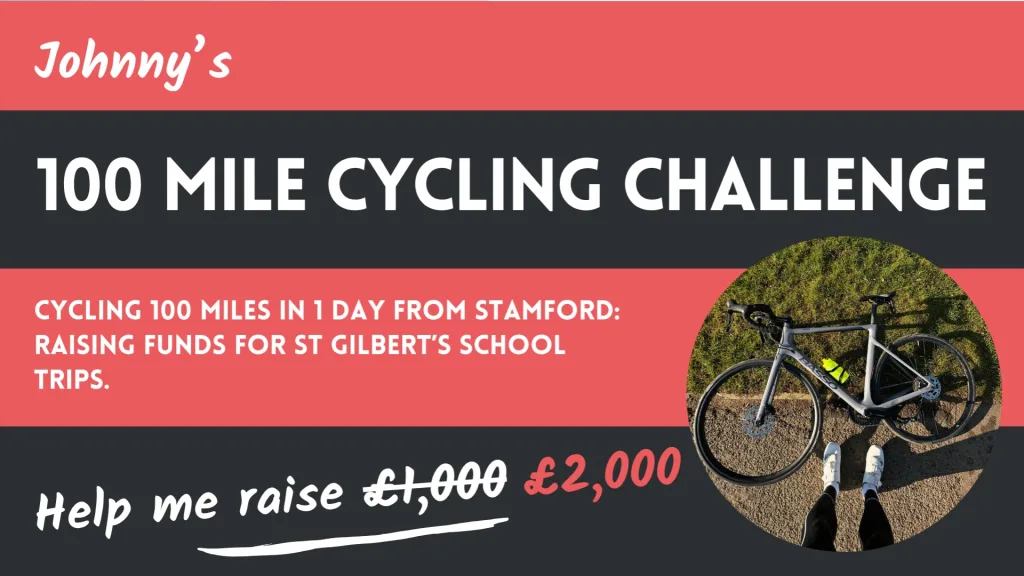
Our second 100 mile bike ride: 27th September 2026
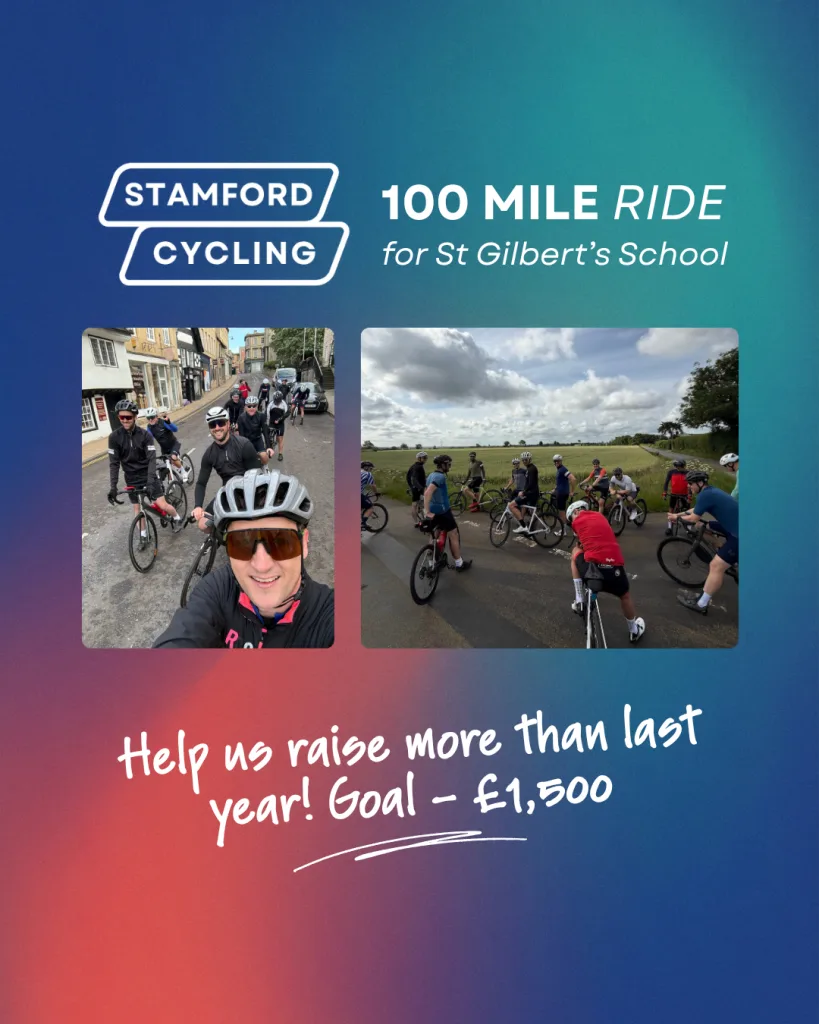
This year’s century is the second running of our St Gilbert’s PTA fundraiser and the big change is that there’s a bigger group of Stamford Cycling riders taking it on together. Some have children at the school, others are doing if for the social.
Ride details:
- Date: Sunday 27th September 2026
- Distance: 100 miles / 161km
- Location: Start outside St Gilbert’s School on Foundry Lane Stamford
- Start time: 6am
- Cause: St Gilbert’s PTA, funding school trips, extra-curricular activities and making sure every child at the school can take part regardless of family circumstances.
👉 Donate to the ride here — every pound goes to the PTA.
Last year the target was £1,000 and we collectively finished with £3,000, which was a genuinely humbling amount from a small town and a small club. This year’s starting target is £1,500.
This year’s 100 mile ride
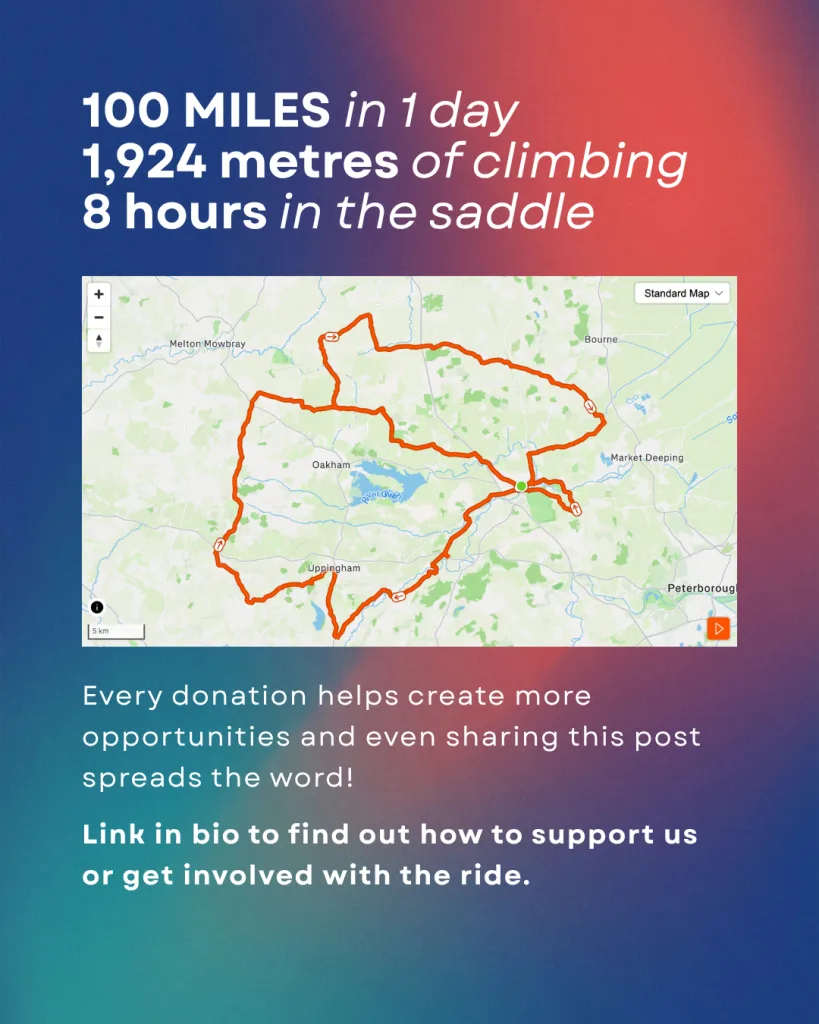
The full 100 mile route is mapped on Strava:
Want to ride it with us?
You don’t have to commit to the full 100 miles. Riding 50km of it and peeling off at a sensible point is genuinely welcome — more riders on the road means more involvement and more people means more donations. Drop us a message and we’ll tell you where to join.


